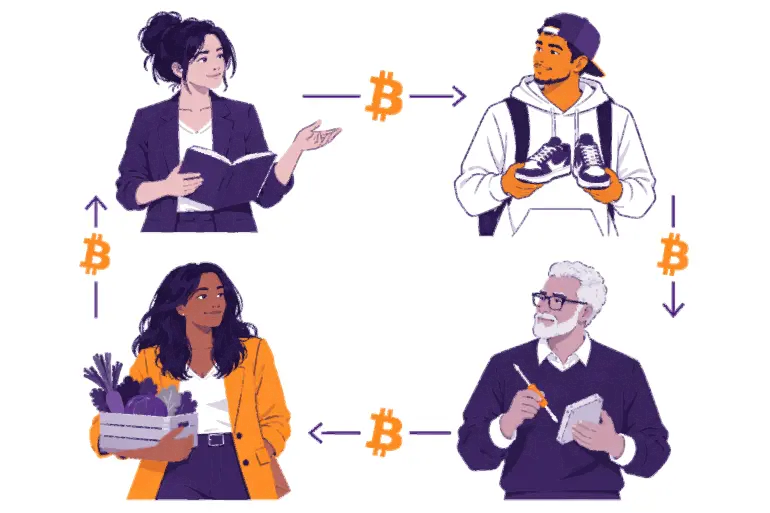
Module 4 applies learning from Modules 1–3 to local daily life. It is a required part of the Bitcoin Diploma, not a free-choice bonus module, and it is not globally defined as “spending.” Every certificated learner completes one approved locally relevant task, but educators select the context because currencies, tools, laws, risks, infrastructure, and community needs vary.
It is the Connect stage of Problem → Solution → Action → Connect. The learner must connect the earlier modules to a local need or opportunity and a realistic existing alternative before practising a safe task. The intended outcome is sound local reasoning and safe performance, not adoption or a favorable conclusion about Bitcoin.
Guiding question:
How do the problem, solution, and safe action connect to this community?
Learner promise:
I can demonstrate one approved local Bitcoin-as-money task and explain its purpose, trade-offs, failure points, safety considerations, and realistic next steps.
If this is your first time teaching Module 4: Do not start by choosing a popular tool. Start with a local need, compare the existing option, verify current facts, and select the smallest safe task that can show useful learning. A well-supported simulation is a successful lesson; a live payment is not required merely to make the module feel practical.
10.2Assessed competency and competency criteria
Assessed competency
Learner must be able to
Competency criteria to cover
Required evidence
C7
Safely complete one approved local Bitcoin-as-money task and connect it to its local purpose, realistic alternative, trade-offs, and next step.
C7.1 Safe task sequence and verification behavior. C7.2 Local purpose, realistic alternative, trade-offs, failure points, safety considerations, and realistic next steps.
Direct observation and explanation during or immediately after performance.
Use guided discussion to support the formative competency F1 and the course-ending reflection to support the formative competency F2. Neither creates a certification gate.
10.3Begin with a need, not a tool
Ask first:
Which Module 1 problem, Module 2 response, and Module 3 safe action are learners connecting?
What real local problem or opportunity are we examining?
How is it handled now?
Which function of money is involved?
Could Bitcoin improve the complete path?
What new cost, custody, privacy, price, legal, operational, or safety risk appears?
Can learners examine or practise the path safely?
What observable action would show the competency?
A valid conclusion may be that Bitcoin is not the best option for the case. The module assesses reasoning and safe performance, not adoption.
10.4The seven-step module builder
Keep the existing non-Bitcoin alternative in view at every step.
1Learn the contextStudy local conditions and consult local people.
2Define the needName one local need, not a product.
3Select the taskPick one primary task, plus one more at most.
4Verify the factsCheck facts, tools and expertise, with dates.
5Design the sequencePlan Presentation, then Practice, then Production.
6Plan the evidenceDefine the observable evidence before class.
7DebriefChoose the smallest safe next step with learners.
common cash, bank, mobile-money, and card payment methods
internet, electricity, data, and device reliability
banking and identity access
common wage, merchant, donation, or remittance patterns
Bitcoin knowledge and tool availability
language and accessibility needs
fraud, coercion, surveillance, and physical-safety risks
legal, tax, accounting, consumer, and reporting context; and
available technical or community support.
Do not ask learners to reveal personal financial details to complete this research. Use public information, voluntary community consultation, and invented cases. The Bitcoin Diploma AI assistant can help you draft research questions and identify gaps to investigate. Verify local conditions through current primary sources and community consultation before using them in a lesson.
2. Define the local need or opportunity
Write one sentence:
Learners will examine whether Bitcoin can help ________ by comparing or demonstrating ________ under the local conditions of ________.
If the sentence starts with a product name, return to the need.
3. Select a focused module
Choose one primary task and, at most, one supporting task for a minimum module. Suitable areas may include:
receiving payment for work
an everyday purchase
family remittance or cross-border payment comparison
Invite a qualified local expert when needed. Brief them on the competencies, no-promotion boundary, privacy rules, and assessment role. The educator remains responsible for the learning environment.
5. Design Presentation → Practice → Production
Presentation: Demonstrate the complete local path, including the non-Bitcoin alternative, costs, custody, failure points, and stop conditions.
Practice: Learners rehearse with printed materials, a simulation, test environment, or approved low-stakes setup.
Production: Learners complete the defined task or direct its decisions with only permitted support, then explain the relevant trade-offs.
6. Make the assessment opportunity clear
Before class, specify:
competency and suitable activity
observable action sequence
required verification behavior
required explanation
permitted prompt level
privacy and consent boundaries
safety-critical errors
offline equivalent
Showing competency: Yes and Showing competency: Not yet; and
optional notes and reassessment route.
7. Debrief and choose a safe next step
Ask learners to identify:
the local need
the existing alternative
the Bitcoin path
who controls the keys and records at each stage
total costs and time
strongest benefit
most serious risk or failure point
locally specific rule or condition
evidence observed; and
smallest responsible next step.
The next step may be further learning, another simulation, checking a current rule, seeking qualified help, or deciding not to use the path.
10.5Module 4 readiness gate
Do not deliver a live Module 4 activity until every check passes
If a check below is not satisfactory, use a simulation, printed route, or a different activity. Do not compensate for an unsafe or unverified route by asking learners to accept more risk.
Do not deliver a live module until every required answer is satisfactory.
Readiness question
Ready when
If not ready
Is the need real and relevant?
The educator can describe the local problem without relying on a product pitch.
Select a better need or use a comparative scenario.
Is the competency clear?
The task maps to concepts from Modules 1–3 and an approved C7 variant, including C7.1 and C7.2.
Do not use it for certification.
Is the educator competent?
The educator can demonstrate, troubleshoot safely, and explain limitations.
Use a qualified expert, simulation, or different module.
Is the tool verified?
Source, custody, recovery, fees, privacy, compatibility, and failure behavior were checked recently.
Use printed screens or remove the tool.
Are local rules understood?
Relevant claims are supported by authoritative current guidance.
State uncertainty and avoid live action requiring that guidance.
Is practice low-risk?
No real secrets are exposed and loss, privacy, or physical risk is controlled.
Use no funds, a simulation, or a prepared environment.
Is access equitable?
Learners can participate despite device, language, disability, or connectivity constraints.
Prepare an equivalent accessible pathway.
Can evidence be observed?
The educator can see the learner's decisions and hear the explanation.
Reduce group size or schedule individual assessment.
Deliver live only when every check passes.
1Real needThe local problem stands without a product pitch.
2Clear competencyThe task maps to Modules 1 to 3 and C7.
3Competent educatorThe educator can demonstrate and explain limits.
4Verified toolIts source, custody and fees are checked.
5Local rulesClaims rest on current authoritative guidance.
6Low-risk practiceNo real secrets, and every risk is controlled.
7Equitable accessEvery learner can take part.
8Observable evidenceYou can see decisions and hear explanations.
1A gap? Use a safer route or revise the plan, then check again.
10.6Module 4 planning record
Complete this before delivery.
Field
Educator record
Module title and variant ID
Local need or opportunity
Problem → Solution → Action concepts to connect
Learner profile and access needs
Modules 1–3 concepts connected
C7 observable task
C7.1 / C7.2 required verification and explanation
Existing non-Bitcoin alternative
Tool, version, source, and date checked
Custody and recovery model
Fees, spreads, limits, and timing
Privacy and identity data
Local legal, tax, accounting, or reporting context
Local expert and role
Presentation steps
Supported-practice steps
Production or assessment task
Stop conditions
No-funds or offline equivalent
Accessibility or language adaptation
Evidence record and reassessment plan
10.7Suggested two-hour Module 4 flow
Time
Learning move
Educator action
0–12 min
Local need
Present the problem and current path; invite learner experience without requiring disclosure.
Show both success and failure paths; explain costs, privacy, recovery, and stop conditions.
48–70 min
Supported practice
Learners rehearse in pairs or stations with educator feedback.
70–90 min
Comparison and local trade-offs
Compare the Bitcoin path with the current alternative through total received, time, fees, custody, privacy, reversibility, and failure.
90–110 min
Production or assessment
Observe the approved individual or team task while preserving identifiable evidence.
110–118 min
Explanation and peer question
Learner explains purpose, benefit, risk, failure point, and next step.
118–120 min
Course bridge
Prepare the final reflection and any reassessment.
If direct observation cannot fit, redesign the scheduled route before delivery: add approved assessor capacity, reduce the cohort, or advertise a longer integrated course. Do not add an assessment-only follow-up after the advertised Bitcoin Diploma.
10.8Local Bitcoin tool review
Do not demonstrate a tool simply because it is popular locally. Use this comparison:
Area
Question
Purpose
Which problem does the tool solve, and is it needed?
Custody
Who controls keys and funds?
Source
Who publishes it, and how was the genuine source verified?
Code and maintenance
Is it open source, reviewed, maintained, and updated safely?
Recovery
What happens when the device, service, or company disappears?
Privacy
Which identity, contact, device, location, and transaction data are collected?
Cost
Which visible fees, spreads, subscriptions, funding costs, and withdrawal costs apply?
Compatibility
Which networks, address types, invoices, backups, and devices work?
Support
Can learners obtain help without sharing secrets?
Law and records
Which local restrictions, consumer rules, tax, accounting, or reporting duties may matter?
Alternative
What can learners use if the tool fails or is unavailable?
This tool is a dated local example for learning. Its use in class is not a global recommendation by My First Bitcoin or a promise that it will remain suitable.
10.9Lightning module checklist
Before a Lightning workshop, verify and explain:
whether the wallet is custodial or self-custodial
how it is funded
whether funding or withdrawal uses an on-chain transaction or service
recovery and continuity if the provider or device fails
whether the request is an invoice, supported Lightning address, or another type
amount, unit, recipient, expiry, fee, limits, and liquidity considerations
what success, pending, expiry, or failure looks like
how both parties independently confirm the result; and
the offline simulation.
It does not prove that the wallet is safe for larger balances or that the same path will work in every place.
Know whether each wallet is custodial or self-custodial.
1Create the requestThe receiver creates a payment request.
2Scan the requestThe sender scans or copies it.
3Verify the detailsCheck recipient, amount, unit, expiry and fee.
4Approve the paymentThe sender approves it.
5Route the paymentIt travels across the Lightning Network.
6Check the resultBoth wallets show success or failure.
1Failed or expired? Confirm on both wallets, then make a new request.
10.10Module option A: local payment-path comparison
Purpose: Compare the complete route for an existing local payment, an on-chain path, and a Lightning path where appropriate.
Setup: Use a realistic invented payment amount and recipient. Prepare dated local fee, exchange, timing, custody, and access information. If data cannot be verified, clearly label it hypothetical.
Learner task: Complete:
Field
Existing method
On-chain Bitcoin
Lightning, if relevant
Amount sent
Total amount received
Time and settlement expectation
Fees and spread
Custody at each stage
Identity and privacy
Reversal or refund
Main failure point
Local support or law
Production: The learner chooses a path for the invented case, demonstrates or sequences the relevant payment request and verification, and explains why the other path might be better under a changed condition.
Debrief: Did Bitcoin improve the complete route, or only one visible step? Who bears volatility, conversion, custody, and failure risk?
Safety: No real transfer or named provider is required. Use printed payment information.
10.11Module option B: small purchase
Purpose: Practise a point-of-sale payment and compare on-chain and Lightning where locally appropriate.
Presentation: The merchant creates the correct request; the customer verifies recipient, payment type, amount, unit, and fee; both parties confirm the result.
Practice: Use a low-value item, test environment, or simulation. Include one failed or expired request.
Production: The learner completes the approved payment role and explains:
why the selected rail fits the amount and timing
who controls the wallet
how receipt is confirmed
what happens if sender and merchant displays disagree; and
when to stop.
Debrief: A fast payment is not automatically private, self-custodial, final in the same way, or suitable for higher value.
10.12Module option C: payment for work or family remittance
Purpose: Map a payment from the payer's starting value to the recipient's usable outcome.
Learner decisions:
Is the obligation priced in local currency, bitcoin, or sats?
When is the exchange rate fixed?
Who pays fees and spreads?
Does the recipient want bitcoin or local currency?
Production: The learner performs or directs a payment and refund scenario. They must authenticate the customer, request fresh return information, check the destination and amount, identify who pays any fee, and record the result without exposing unnecessary data.
Debrief: Why is sending a refund automatically to an assumed original address unsafe? Who becomes responsible when several staff share one wallet?
10.14Module option E: community donation
Purpose: Design a safe donation route for a nonprofit, classroom project, or simulated community group.
Learners decide:
how donors verify the genuine payment request
whether receipt is on-chain, Lightning, or both
who controls the wallet and backup
who can authorize spending
what transparency is useful
which donor information should remain private
what records may be required
how a mistaken or fraudulent request is handled; and
what happens if the custodian, device, or service fails.
Production: Demonstrate a verified sample donation request and explain custody, transparency, privacy, and the main failure point.
Safety: Do not collect real donations during an assessment unless an approved organizational process, consent, records, and legal review already exist. A simulation usually serves the learning competency better.
10.15Module option F: on-ramp, off-ramp, KYC, and no-KYC comparison
Purpose: Compare routes without recommending acquisition or evasion.
Include earning, direct exchange, a service, an ATM or kiosk, merchant use, or conversion where locally relevant.
Ask:
What identity data are collected?
Who stores them and for how long?
What is the full price, spread, fee, and withdrawal cost?
Can bitcoin be withdrawn to a wallet the learner controls?
When is the fiat side final or reversible?
What fraud, counterparty, physical, and privacy risk exists?
What support or dispute process exists?
Which local rule applies?
1Send from the phone
A person at a Bitcoin ATM sends bitcoin from their phone.
2Collect the cash
The machine pays out local cash.
Production: The learner chooses a path for an invented case, sequences the safe checks, and explains which risk is reduced and which is added.
Safety: Do not facilitate an actual peer-to-peer cash trade as a default classroom exercise. Never direct learners to evade KYC, tax, exchange, or other local rules.
10.16Module option G: circular economy and local resource map
Purpose: Evaluate whether a voluntary local loop solves a real problem.
Map:
who can earn bitcoin.
where it can be used.
which merchants can pay suppliers or workers.
who must exchange to or from fiat.
who controls keys at each stage.
who provides education and technical support.
what happens when internet or electricity fails.
what price, custody, fraud, and privacy risks participants carry; and
whether the loop depends on giveaways or one organizer.
Customer
The customer pays a merchant in bitcoin for goods.
Merchant
The merchant pays a service provider in bitcoin for a service.
Service provider
The service provider pays a worker in bitcoin for their time.
Worker
The worker spends that bitcoin again as a customer.
For resource discovery, verify:
when a listing was last checked
whether the merchant or group still operates
which payment method is accepted
whether an alternative payment is available
whether publication has consent; and
whether the contact is offering education or promoting an investment or private exchange.
Production: The learner verifies one prepared resource, adds it to the map with a date and safety note, and explains how it supports or fails to support a local loop.
Safety: A map listing, meetup membership, or community reputation is not proof of trustworthiness. Do not publish home locations or private contacts.
10.17Community custody and shared funds
If one person or group controls bitcoin for others, they are acting as a custodian. Explain the added responsibilities:
Ask another learner to pose one verification question and identify one trade-off.
Team presentation does not provide individual certification evidence. Each learner seeking certification must produce individually identifiable practical evidence against the C7 rubric, including C7.1 and C7.2, under direct observation by an educator.
Then use the Module 4 Student Guide closing question. Keep the response private or optional, following the light module-closing reflection guidance above.
Close with:
Bitcoin can function as money when people voluntarily use it to earn, save, receive, send, spend, price, or settle value. The Connect stage begins with a real need, compares a realistic alternative, makes custody and costs clear, respects local law and safety, and leaves people free to decide.