Does your money buy the same amount today as it did in the past?
As you discuss these questions, notice the difference between a fact and an opinion. “This note is accepted for taxes” is a fact that can be checked. “This is the best form of money” is an opinion or conclusion that needs criteria and evidence.
1.2Why money exists
People have different skills, resources, needs, and plans. Exchange allows them to specialize: a farmer can grow food, a builder can build homes, and a nurse can provide care. For this specialization to work at scale, each person needs a practical way to exchange the value of their work for the work of others.
Direct exchange is often difficult. The person who has what you need may not want what you offer. Money solves this coordination problem.
Money
Money is an asset that people accept because they expect other people to accept it later. It helps strangers coordinate exchange, record prices and debts, and move value across time and distance.
Money helps strangers cooperate across time and distance, and at scale. For example, a worker can earn money today and spend it next year on a bicycle made in another country, paying for the work of many people they have never met. Money also creates a common way to record prices, debts, income, costs, and savings.
Money is not the food, home, time, or skill that people value. It is a tool for measuring and exchanging claims on those things. Its usefulness depends on trust, rules, social acceptance, and its monetary properties.
Spot question: Why did money come into existence? Explain the exchange or coordination problem it helps people solve.
1.3Functions and properties of money
Money usually performs three main functions.
Medium of exchange: People accept it in payment for goods and services. This reduces the need for direct barter.
Unit of account:Prices are expressed in a shared unit. This allows people to compare the cost of different goods and keep financial records.
Store of value:Value can be moved from the present into the future. Every form of money has risks to purchasing power, but people compare how well different forms preserve it across a chosen period and situation.
An item can perform one function better than another. In many current monetary systems, a national currency is widely accepted for daily payments while people may choose another asset for long-term saving.
Useful money also tends to have several properties:
Durability
Can it remain usable over time?
Portability
Can people move or transfer it easily?
Divisibility
Can it represent both small and large amounts?
Fungibility
Are equal units normally interchangeable?
Useful money
Scarcity
Can its supply increase quickly, and who can change it?
Acceptability
Will other people receive it in exchange?
Verifiability
Can people check that it is genuine and readily identify equivalent units?
No form of money scores perfectly.
People also compare money by its soundness: whether its supply is difficult to expand and whether its properties support reliable use across time. “Sound money” is a judgment, not a fact label. To use it well, state the criteria and compare different forms of money by the same standards.
Functions
Medium of exchange, unit of account, store of value.
Gold is durable and scarce but difficult to divide and transport for small payments. Paper cash is portable and accepted locally, but it can be damaged and its supply can expand. The best comparison depends on the purpose, place, and time.
Think critically: Name a time when you chose one type of money or asset over another. What was the purpose? Compare the properties of the options you could have used. Which properties mattered most to you, and why?
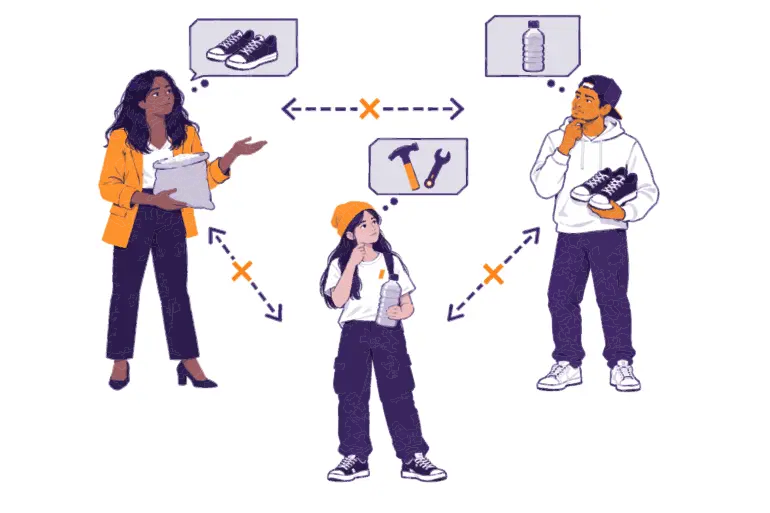
Barter is the direct exchange of one good or service for another. It can work well in a small exchange, but becomes difficult when many people and products are involved.
Imagine that Amina has rice and wants shoes. Luis has shoes but wants cooking oil, not rice. Mei has cooking oil and wants repair work. Amina may need several exchanges before she can obtain the shoes. Each exchange takes time and requires agreement about value.
Amina
Has: rice
Wants: shoes
With Luis
Luis does not want rice.
Luis
Has: shoes
Wants: oil
With Mei
Mei does not want shoes.
Mei
Has: oil
Wants: repairs
With Amina
Amina cannot do repairs.
For barter to work directly, each person must want what the other person offers at the same time and in suitable amounts. Economists call this the double coincidence of wants.
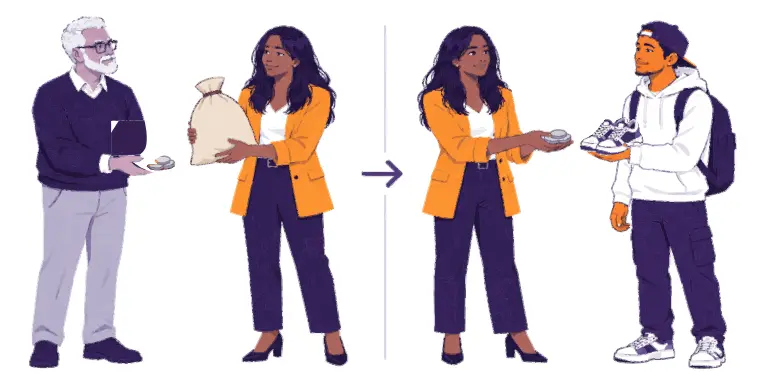
A commonly accepted money separates selling from buying. Amina can sell rice to one person for money and later use that money to buy shoes from someone else.
1First, she sells
Amina sells her rice to one person for money
2Later, she buys
She uses that money to buy shoes from someone else
Scarcity means that choosing one use of a resource prevents another use. Time, land, energy, good health, tools, and sound money are all scarce.
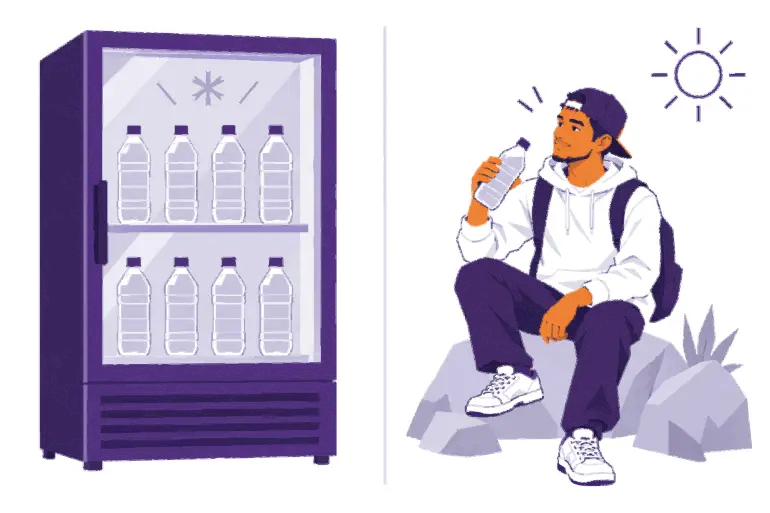
The value of a good is not contained inside the object. People value goods according to their needs, preferences, information, and circumstances. This is sometimes called subjective value. Clean water may be inexpensive near a safe public source and extremely valuable during a shortage.
Near a safe source
A bottle of water sits in a store fridge.
Clean water is easy to find nearby.
Need
Low
Price
Lower
During a shortage
The same bottle sits in a hot desert.
Water is hard to find and badly needed.
Need
Urgent
Price
Higher
Exchange happens when both sides prefer what they receive to what they give up. They do not need to agree that the two items have the same personal value. They only need to agree to the terms.
Three ideas help explain everyday choices:
Opportunity cost is the best alternative you give up when you make a choice. Money spent on transport cannot also be spent on food.
Time preference describes how strongly a person prefers value now instead of later. Urgent needs can create a high preference for the present. Saving for a future goal shows a greater willingness to wait.
Trade-off means gaining one benefit while accepting a cost or giving up another benefit.
A shopper with limited money weighs the options
Food
Eat well today.
Transport
Get to work.
Save
Keep it for later.
Each choice gives up the others: the opportunity cost
Scarcity alone does not guarantee value. An item may be rare and still have no demand. A useful monetary asset combines limited supply with properties and demand that make people willing to hold or exchange it.
1.6Beginner monetary history from barter to digital money
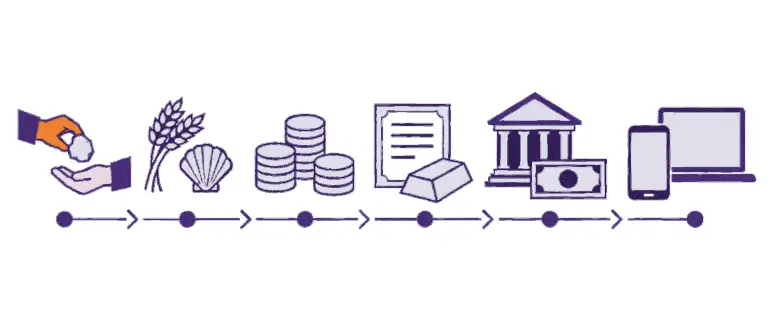
Money did not develop in one identical sequence everywhere. Different societies used different goods, records, and institutions. However, a broad pattern helps explain modern money.
“Money … is by no means the result of an agreement … but is the unintended product of historical development.” Carl Menger, “On the Origin of Money” (1892)
Direct exchange and local records: People used barter, gifts, obligations, and written or remembered debts. These systems depended strongly on local relationships.
Commodity money: Communities selected goods that were widely valued and easier to trade. Salt, beads, shells, livestock, copper, silver, and gold have served monetary roles in different places. A commodity has a use or value beyond an issuer's promise.
Standard coins: Authorities measured and stamped metal into standard units. Coins improved recognition and accounting. Authorities could also reduce the precious-metal content of these coins while keeping the same stated value. This is called debasement.
Representative paper: Transporting and protecting metal was difficult. Depositories and banks issued paper claims that could be redeemed for a stated amount of metal. The paper was easier to move, but users had to trust the issuer to keep enough metal and honor redemption. Under different versions of a gold standard, a currency unit was legally connected to a stated amount of gold. The rules varied by place and period, and governments or banks sometimes suspended or ended convertibility.
Bank and government money: Banks issued more claims and credit. Governments created central banks and national currency systems. Money became increasingly based on institutional records and promises rather than direct possession of a commodity by the population. In many countries, national currency later became no longer redeemable for a physical asset such as gold. This separation from commodity backing is a defining feature of today’s fiat money (see below).
Digital money: Much of today's money moves as digital records through banks and payment services. A card or phone sends an instruction; it does not contain money by itself. Usually, the instruction changes a bank deposit, meaning the bank's recorded obligation—or claim—to pay the account holder an amount in the national currency.
This history shows repeated trade-offs. Convenience increased, but users often became more dependent on monetary policy, issuers, banks, and payment intermediaries.
Fiat money is currency issued under government authority, usually through a central bank, that is not redeemable for a fixed amount of a commodity such as gold. Governments support—and in some contexts impose—its use by requiring it for taxes and by setting legal-tender rules. The exact rules for accepting payments and settling debts vary by jurisdiction.
Fiat money works because people, businesses, banks, and governments accept it. All money can develop network effects: people use it because other people use it and prices are stated in it. For fiat money, tax obligations, legal-tender rules, and institutional payment systems can reinforce that network.
The fiat system has several main participants:
Central bank
Manages monetary policy and supports payment settlement.
Commercial bank
Owes customers their deposits; a deposit is the bank's liability.
Payment services
Carry payment instructions that change bank deposits.
Government
Collects taxes and spends, under its own laws.
Citizens and businesses
Hold deposits, pay, get paid and pay taxes.
Varies by country
Exact institutions and rules differ from place to place.
Choose one ordinary payment in your community, such as buying transport, food, or phone credit; receiving wages; or paying a bill. Use a realistic invented scenario if you prefer. In three or four sentences, explain:
why the seller or recipient is willing to accept that currency; and
which institutions, records, or rules people rely on to complete the payment.
Finish by naming one way the payment would become harder if that shared acceptance or trust broke down.
Fiat systems can provide convenient payments, flexible credit, and tools for responding to financial crises. The same flexibility creates risk. A small number of institutions can change the supply and cost of money, restrict access, or make decisions that reduce purchasing power.
Fiat money requires layers of trust. Users trust banks to keep accurate records, payment services to process transfers, central banks to manage the currency, and governments to maintain lawful institutions. These systems can work for long periods, but their rules are not fixed and can be open to neglect or abuse.
When you deposit cash in a bank, the bank records a liability to you: it owes you the account balance. The bank does not normally keep every unit of every deposit as physical cash. Instead, it keeps liquid reserves—cash or assets it can use quickly for payments—and uses its balance sheet to make loans and other investments.
When a commercial bank approves a loan, it usually creates a new deposit in the borrower's account. This expands the amount of bank deposit money. When the principal is repaid, that deposit money is reduced. Banks are limited by capital rules, liquidity needs, credit risk, regulation, the cost of funding, and demand from qualified borrowers.
1Apply for the loanThe borrower asks the bank for a loan.
2Approve the loanThe bank agrees to lend.
3Create the depositThe bank credits a new deposit to the borrower's account.
4Spend or transferThe borrower uses the deposit to pay others.
5Repay with interestThe borrower repays the bank the principal plus interest.
Banks generally seek profit by earning interest and fees on loans and investments while paying their operating, funding, and regulatory costs and absorbing losses when borrowers do not repay. These activities and constraints differ by bank and jurisdiction.
Fractional reserve banking
Fractional reserve banking describes banking in which banks hold only a fraction of their deposit obligations as immediately accessible reserves while making loans and holding other assets. The required reserve level and other limits differ between countries and can change over time.
This creates two important risks:
Liquidity risk: A bank may own long-term loans that are expected to be repaid but still lack enough cash or quickly usable assets for many withdrawals today.
Solvency risk: Failed loans or falling assetvalues may leave the bank's total assets worth less than what it owes. In that case, the bank cannot fully meet its obligations even if it has time to sell assets.
Liquidity risk
Many depositors queue to withdraw today
The bank's loans may still be repaid later
Not enough cash or quickly usable assets now
The problem
Timing: cash is short today
Solvency risk
Borrowers stop paying their home loans
Failed loans lose their value for the bank
Total assets are worth less than what the bank owes
The problem
Value: time to sell does not help
A bank run happens when many depositors try to withdraw their money or account balances at the same time because they fear the bank may fail. Deposit insurance and central-bank lending can reduce panic, but insurance eligibility and coverage limits vary by jurisdiction. These protections depend on institutions and rules, and they can move some losses or risks from an individual bank to the wider system.
Regulation and oversight can reduce risk, but they cannot prevent every case of fraud, poor management, political abuse, or simple error. These failures are possibilities to evaluate, not outcomes of every banking system.
The central lesson is not that every bank is about to fail. It is that a bank balance is the bank's promise to pay you. It is not the same as holding the settlement asset directly.
People use the term “inflation” in more than one way. In this guide, price inflation means a sustained increase in the general price level of goods and services. If your income and savings do not rise as quickly as prices, your money buys less.
Purchasing power
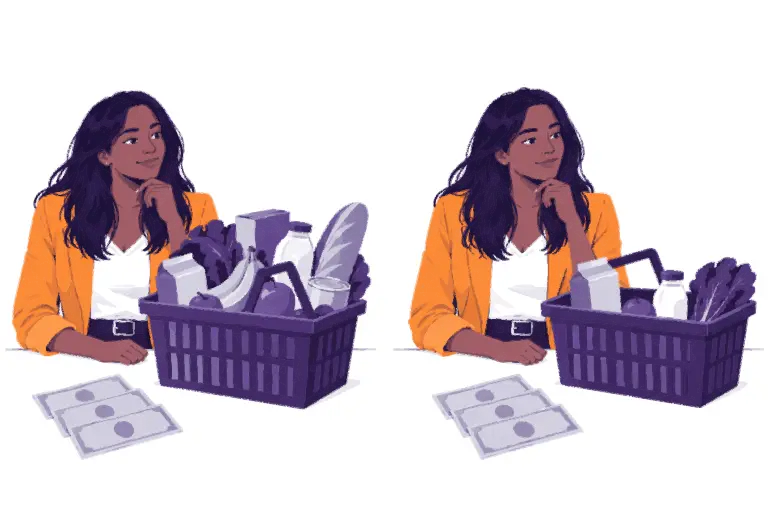
Purchasing power is the amount of goods and services a unit of money can buy. If a basket of basic goods rises from 100 units of currency to 110, the same 100 units no longer buy the full basket. Its purchasing power in relation to that basket has fallen.
Before
You hold 100 units.
The basket costs 100.
You can buy the full basket.
Price level
Lower
Purchasing power
Higher
After prices rise
You still hold 100 units.
The same basket costs 110.
You can no longer buy it all.
Price level
Higher
Purchasing power
Lower
Some people use “inflation” to mean monetary expansion: an expansion of money and credit. That expansion can contribute to price inflation, alongside supply disruptions, changes in demand, currency weakness, taxes, regulation, and changes in production costs. The causes and effects are often debated. Avoid explanations that assign every price change to one factor.
Inflation does not affect everyone equally. A person who holds mainly cash may lose purchasing power. A person who owns an asset that rises in price may be partly protected. Borrowers may repay fixed debts with money that buys less, while lenders may receive less real value than expected. Wages and prices also adjust at different speeds. These later, indirect results are sometimes called secondary effects.
The rate of inflation is an average. Your personal experience may differ because your spending is not identical to the measured basket. Food, housing, transport, education, and health costs may change at different rates.
Choose one ordinary item in your community. Record its price today. Ask what it cost several years ago, then check a reliable record if possible. Did income change at the same rate? What other factors may explain the change?
Then compare your item with an official inflation measure. Which goods and services are in that measure's inflation basket? Has the basket or method changed over time, and does the source explain why? A change is not automatically manipulation, but it can affect comparisons and should be documented transparently.
1.10Why the US dollar is a world reserve currency?
A reserve currency is a currency that central banks and governments hold and use for international payments. Before the First World War, the British pound played this role most strongly. The war weakened European currencies and financial centers, while the United States supplied goods and accumulated gold. This increased international use of the dollar.
After the Second World War, the United States had a large economy and much of its financial capacity intact. The 1944 Bretton Woods Agreement then organized a postwar system in which many currencies were linked to the dollar and the dollar was officially linked to gold, placing the dollar at the center of international payments.
In 1971, President Nixon ended the official exchange of dollars for gold by foreign governments and central banks. This ended the dollar's official goldconvertibility and brought the Bretton Woods system to an end. The dollar nevertheless remained widely used because of its established role in trade and finance, the size of the U.S. economy, and the depth of U.S. financial markets. It remains the leading reserve currency today, although central banks also hold other currencies and its share can change over time.
People often seek alternatives to holding cash when they believe it will lose purchasing power. Common choices include precious metals, real estate, and stocks. Precious metals have also served as money in many places and periods. Each option has benefits and risks.
Alternative
Why people may choose it
Important trade-offs
Precious metals
Long history, physical possession, limited supply
Storage, verification, transport, security, and difficult small payments
Real estate
Useful physical asset, possible rent, limited desirable locations
High entry cost, maintenance, taxes, legal dependence, and low portability
Stocks
Ownership in productive businesses, possible income and growth
Business risk, market volatility, custody through institutions, and need for financial knowledge
An asset is something a person can own or claim that may have value; it does not automatically perform every function of money. A home may store value but is not practical for buying food. A share may be easy to sell in one country but unavailable to someone without a brokerage account. Gold has served as money across long periods of history but can be difficult to verify or divide during a small exchange.
People may also choose foreign currency, government bonds, private businesses, land, tools, education, or other assets. Every choice includes opportunity cost and risk. There is no asset that guarantees purchasing power in every period and situation.
Note: Tax treatment can also shape these decisions. Rules for income, gains, property, and transactions can change the cost or benefit of holding, selling, or using an asset. Tax rules vary by jurisdiction and can change over time; this course does not provide tax advice.
Bitcoin emerged as another proposed alternative: a scarce digital asset that can be held and transferred without a central issuer. To evaluate that claim, we must study why Bitcoin was created and how its rules work.
CBDC designs differ. Some are intended mainly for financial institutions; others are proposed for public use. First ask who the issuer is: with a CBDC, the central bank remains the issuer and can still apply monetary policy. A CBDC therefore does not create a fixed monetary supply or remove central control; it simply changes the technology and distribution of fiat money.
Next ask what the design allows. Depending on the rules, a CBDC may allow faster settlement, wider access, or new payment features. It may also give institutions greater ability to monitor transactions, apply rules, limit use, or connect identity directly to payments. This is centralized control: an institution, rather than ordinary users independently, sets or changes the relevant rules.
Question
Cash
Bank deposit
Retail CBDC
Bitcoin
Who issues it
Central bank
Commercial bank
Central bank
No issuer
Form
Notes and coins
Digital balance
Digital
Digital
Who can use it
Whoever holds it
Accepted customers
Depends on the design
Anyone
Who sees payments
Payer and payee
The bank
Depends on the design
Everyone, without names
Supply rules
Central bank
Banks and central bank
Central bank
21 million limit
Verify it yourself
Check the note
Trust the bank
Depends on the design
Run a node
Digital does not automatically mean decentralized, scarce, private, or open to independent verification. A CBDC may use digital technology, but it is still fiat money if its issuer, supply rules, access rules, and payment permissions remain centrally managed.
Pause and consider the money you use: what makes it useful in daily life, and which of its rules depend on institutions you must trust? Barter is difficult because matching needs is inefficient. Fiat money makes exchange easier, but its changing supply, institutional control, restricted access, and declining purchasing power can create serious flaws for people who rely on it. People may disagree about how serious each flaw is or how to address it. This is why some people look for monetary alternatives with different trade-offs around supply, control, access, and trust.
Key takeaways
Money helps people exchange, compare prices, record value, and move value across time.
Some people look to alternatives such as precious metals when they want different trade-offs around purchasing power, supply, or control; every alternative has limits and risks.
A moment to reflect
What is one question you now ask about money that you did not ask before?
The next module examines Bitcoin's attempt to create a different set of monetary rules.