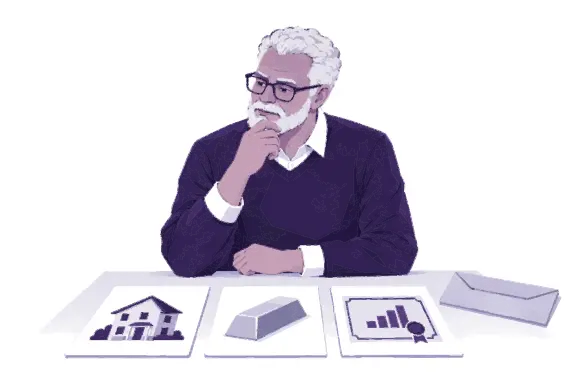
Not earning it, not spending it, but actually thinking about what it is and how it works.
We use money every day, yet rarely ask how it works.
Before you read on, take a moment with five questions. Write a short answer to each one if you can:
Why do people need money?
What makes something money?
Who can create or control the money you use?
Why does the money you use have value?
Does your money buy the same amount today as it did in the past?
Keep your answers. Come back to them at the end. This guide may strengthen some of your views and change others.
As you read, notice the difference between a fact and an opinion. "This note is accepted for taxes" is a fact that can be checked. "This is the best form of money" is a conclusion that needs criteria and evidence.
This guide is built around six questions: why money matters, what it is, what can go wrong with it, what Bitcoin is, how to use it safely, and what comes next.
It is for education only. It does not provide financial, investment, legal, or tax advice, and it does not tell you to buy, sell, or hold anything.
What is Money?
Money is a tool for exchange.
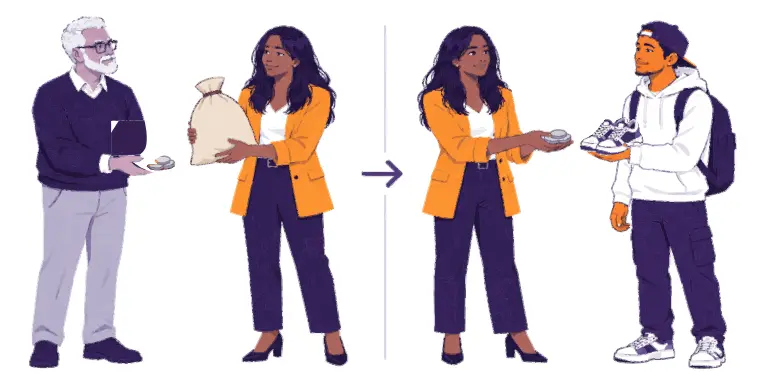
Nobody wants money for its own sake. We want it for what it can buy. A banknote is just a piece of paper. What makes it useful is that other people will accept it in exchange for things we actually want, because they expect others to accept it later.
This is what separates money from barter.
In a barter system, trading only works when both people want what the other has, at the same time and in suitable amounts. Economists call this the double coincidence of wants. If you grow rice and need shoes, the shoemaker may want cooking oil, not rice. Money solves this by separating selling from buying: you sell your rice to one person and buy shoes from another.
Money usually does three things.
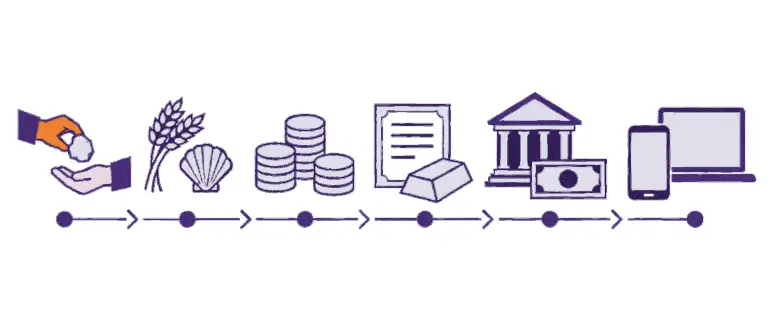
It is a medium of exchange: people accept it in payment. It is a unit of account: prices are expressed in it, so we can compare the value of different things. And it is a store of value: it moves value from today into the future. No money stores value perfectly, but some forms lose purchasing power more slowly than others.
Throughout history, many things have served as money: shells, salt, beads, livestock, copper, silver, and gold. Precious metals became widely used because they were scarce, durable, and widely accepted. But carrying and protecting metal is difficult, so banks began issuing paper claims that could be redeemed for a stated amount of metal. Under different versions of a gold standard, a currency unit was legally linked to an amount of gold. The rules varied by place and period.
Over time, money came to rest more on institutions and promises than on metal. In 1971, the United States ended the official exchange of dollars for gold by foreign governments and central banks. Today, most national currencies are fiat money: currency issued under government authority, usually through a central bank, that cannot be redeemed for a fixed amount of gold or any other commodity. The word fiat is Latin for "let it be done", often understood as "by decree".
Fiat money works because people, businesses, banks, and governments accept it. Laws usually make it legal tender and require it for paying taxes, and people want it because everyone around them uses it.
We went from money backed by something, to money backed by trust in someone.
What's Wrong With Our Money?
When people hear the word inflation, they usually think of prices going up.
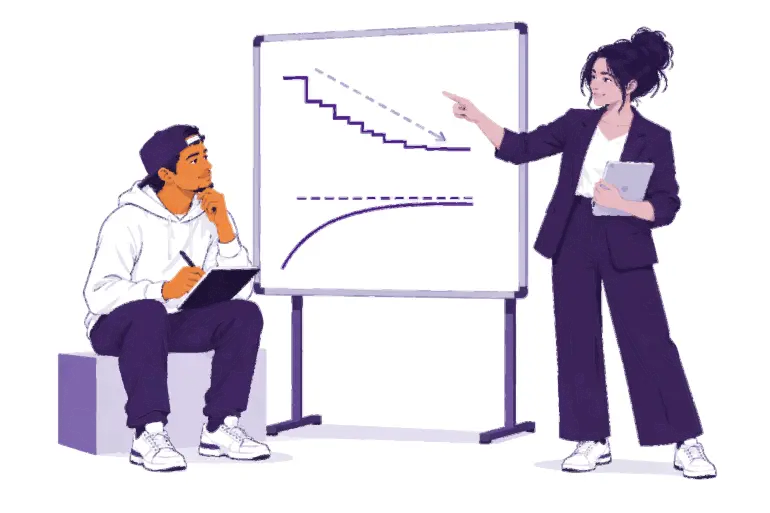
Price inflation is a sustained rise in the general level of prices. Its other side is purchasing power: how much a unit of money can buy. If a basket of basic goods rises from 100 units of currency to 110, the same 100 units no longer buy the full basket.
Inflation has several causes, and economists debate how much each one matters: an expansion of money and credit, supply disruptions, changes in demand, a weakening currency, taxes, and production costs. One cause deserves attention because it is a choice, not an accident: in a fiat system, a small number of institutions can increase the supply of money and credit and change its rules.
Think about what makes something valuable.
The original Mona Lisa is worth more than any copy of it, not because it looks better, but because it's the only one. Scarcity alone does not create value, but when people want something, its supply matters.
When the supply of money grows faster than what it can buy, each unit tends to buy less.
Inflation does not affect everyone equally. A person who holds mostly cash or savings may lose purchasing power. A person who owns assets that rise in price may be partly protected. Wages and prices also adjust at different speeds.
The money in your bank account is also different from cash in your hand. A bank does not keep every deposit as cash: it lends and invests most of it. A bank balance is the bank's promise to pay you. That promise usually holds, but it depends on the bank and on the rules around it.
Try it: a purchasing-power check
Choose one ordinary item in your community, such as bread, transport, or phone credit. Write down its price today. Ask someone what it cost several years ago, then check a reliable record if you can. Did incomes rise at the same rate? What else might explain the change?
None of this means fiat money does not work. It offers convenient payments, flexible credit, and tools for responding to crises. But the same flexibility creates risk: its supply and rules can change, and the people who use it have little say.
This is why people look for alternatives, and why Bitcoin was created.
What is Bitcoin?
Before Bitcoin, sending money online always depended on a trusted organization: a bank or payment company that kept the ledger, approved accounts, and could delay, block, or reverse a payment. For decades, computer scientists tried to create digital money without a central issuer. The hard part was that digital information is easy to copy. If a digital coin could be copied and spent twice, it could not work as money. This is called the double-spend problem.
On 31 October 2008, a person or group using the name Satoshi Nakamoto published a paper describing a solution: Bitcoin: A Peer-to-Peer Electronic Cash System. The network started in January 2009.
Bitcoin is digital money that is decentralized, has a limited supply, and can be sent peer to peer without a bank's permission.
Being decentralized means there is no central office that can create accounts, change balances, or approve who joins. Anyone can download and inspect the open-source software, and many independent computers keep a copy of the record. This does not mean everyone has equal influence. It means no single participant can change the ledger or the monetary rules for everyone.
Having a limited supply means there will never be more than 21 million bitcoin. New bitcoin are released on a public schedule, and independent computers called nodes reject any block that breaks that rule. The limit is credible because anyone can check it. It is not a law of nature, though: it holds because participants keep enforcing it. And a limited supply does not guarantee that the price will rise. Price depends on demand as well as supply.
Being peer to peer means you can send bitcoin to anyone, anywhere, without opening an account with the Bitcoin network or asking a central authority for approval. No company can freeze bitcoin that you control yourself. The other side of that freedom is responsibility: a valid transaction is usually impossible to reverse, and there is no help desk for the network.
One misconception is that Bitcoin is out of reach because one bitcoin is expensive. You do not need to buy or use a whole bitcoin. One bitcoin divides into 100,000,000 smaller units called satoshis, or sats. Owning 100,000 sats and owning 0.001 bitcoin describe the same amount.
The network relies on different participants: users who send, receive, and hold bitcoin; nodes that check every transaction and block against the rules; and miners who compete to add a new block to the record about every ten minutes. That record, the blockchain, is public and visible to anyone, and it is very costly to rewrite.
A note on spelling: Bitcoin with a capital B usually means the network or the system. bitcoin with a lowercase b means the money itself.
Bitcoin also has trade-offs. Its price can change quickly. Mistakes are usually permanent. Acceptance is still limited in many places, and using it safely takes some learning. Bitcoin replaces some trust in institutions with verification and personal responsibility. It does not remove risk.
How Do You Use Bitcoin?
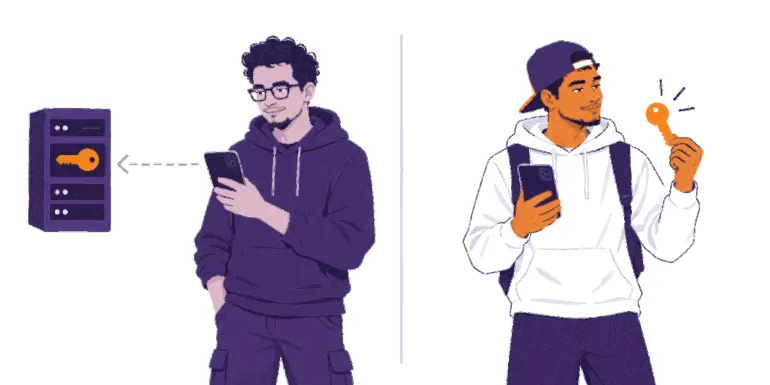
A Bitcoin wallet is a tool, usually an app, that lets you receive, check, and send bitcoin. Your bitcoin is not stored inside your phone: it is recorded on the blockchain. The wallet manages the keys that let you prove it is yours and authorize a payment.
So the first question about any wallet is: who controls the keys?
Who actually holds your bitcoin?
With a self-custodial wallet, you control the keys.
When you set it up, it shows you a seed phrase (also called a recovery phrase): an ordered list of words, often 12 or 24. It can recreate your keys on another device. Anyone who has it can take your bitcoin. The seed phrase is not only a backup: it is full access.
Protect it:
write it down accurately on paper when you create the wallet;
keep it offline, private, and somewhere it will not be lost or damaged;
never photograph it, email it, store it in cloud notes, or send it in a message;
never type it into a website.
If you lose your seed phrase and your device, nobody can recover your bitcoin for you.
With a custodial wallet, a company holds the keys for you, a bit like a bank. Your balance is the company's promise to pay you. Setup is familiar and support may be available, but you depend on that company: it can limit withdrawals, freeze an account, be hacked, or shut down.
Question
Custodial
Self-custodial
Who holds the keys?
The company
You
Who handles recovery?
The company, through your account
You, through your seed phrase
Main trade-off
Convenience and support, but you depend on the company
Direct control, but you are responsible for backups and mistakes
A useful phrase in the Bitcoin world: not your keys, not your coins. Choosing custody is not a test of worth. What matters is knowing which kind you are using and what you are trusting.
My First Bitcoin does not recommend specific wallets. Tools, fees, and owners change, and what suits one community may not suit another. Ask a trusted educator what people use locally, and check these points yourself before using any wallet:
Keys: who controls the keys, you or a company?
Recovery: what happens if your phone is lost or the company disappears?
Source: did you download it from the official website or app store listing, not from a link someone sent you?
Code: is it open source and actively maintained? (Open source alone does not prove a tool is safe.)
Costs: what fees apply to sending, receiving, or withdrawing?
Payments: does it support the payments you need, on-chain or Lightning?
Bitcoin has two common ways to pay. On-chain payments are recorded directly in the blockchain. Lightning is a payment network built on top of Bitcoin for fast, small, frequent payments, such as buying a coffee. A Lightning wallet can also be custodial or self-custodial.
Three rules will keep you safe while you learn:
Learn first. Do not act because of excitement, fear, or pressure.
Start small. Try unfamiliar tools with an amount you can afford to lose.
Don't Trust, Verify. Check the person, the payment method, the address, and the amount before you approve a payment.
Share receiving information, never secrets. An address or a payment request can be shared. A seed phrase or private key must never be shared. No legitimate educator, wallet company, or support worker will ever ask for it.
Stop if someone creates urgency or secrecy, promises guaranteed returns, asks you to send bitcoin first, or asks for your seed phrase. Pause. Share nothing. Send nothing. Then check through a source you already know.
What's Next?
Money depends on rules and trust
Fiat money makes payments convenient, but its supply and rules are set by a small number of institutions, and its purchasing power can fall over time.
Bitcoin offers different rules
Since 2009, Bitcoin has offered money with a public, limited supply, open to anyone, that can be checked rather than trusted. It also brings trade-offs: price swings, permanent mistakes, and personal responsibility.
Safety comes first
Learn first, start small, and verify everything. Never share your seed phrase. You don't need to do everything at once: one safe next step is enough.
This is just the beginning
Go back to the five questions at the start. What would you answer now?
The Bitcoin Diploma is the next step. Its four modules take you further, from understanding money, to how Bitcoin works, to using Bitcoin safely, to Bitcoin in your community. Stay curious, keep asking questions, and learn more at myfirstbitcoin.org.