Module 4 of 4

Bitcoin in Your Community

Listen to this chapter

4.1Bitcoin in Your Community

This is the Connect stage of the Bitcoin Diploma. You will connect the modern money-system flaws and trade-offs, Bitcoin's response, and safe-use responsibility from Modules 1–3 to a local need or opportunity, a realistic alternative, and a safe practical task. You are not expected to adopt Bitcoin or conclude that it is the best option in every local situation.

Bitcoin is one global protocol, but people use it under different local conditions. Internet access, phones, laws, taxes, currencies, banks, merchants, fees, language, safety, and technical support all affect what is useful.

Your educator selects the learning activities in this module. The goal is not to demonstrate every tool. It is to connect concepts from Modules 1–3 to real choices in your community. The educator may invite a local expert when specialized knowledge is needed.

Use the Module 3 safety checklist throughout every local module. Using bitcoin or a named tool in a supervised exercise does not mean that My First Bitcoin or your educator recommends frequent, ongoing, or higher-value use. The purpose is to compare the option and its trade-offs well enough to make your own decision.

Record the focus of your Module 4:

Local learning focusYour notes
Local problem or opportunity
Realistic alternative
Safe practice or scenario
Main benefit and risk
Safe next step

4.2Your local Module 4

In this module, you will apply an idea from Modules 1–3 to a real need or opportunity where you live. You may explore earning, saving, receiving, spending, merchant use, community resources, or another local use of Bitcoin as money.

This matters because Bitcoin is experienced locally. You will better understand what is useful, what is not, and which conditions and risks shape a responsible choice. You will also become familiar with local Bitcoin tools, resources, and organizations without being expected to use or recommend them.

Your educator will guide you because they understand the local context. They may invite a local expert to help you learn from experience and interact positively and respectfully with your community. The goal is to build informed connections and help foster community, not simply to complete a transaction.

Your local Module 4 activity will help you:

Connect

Link earlier learning to a local need.

Compare

Weigh Bitcoin against a realistic local option.

Practice safely

Try a defined task with guidance.

Explain

Share what you learned and a next step.

Your activity may explore questions such as:

  • Can a local worker receive bitcoin for a service?
  • Can a family compare a remittance path with an existing local method?
  • Can a merchant accept payment without holding a large bitcoin balance?
  • Can a community receive support while keeping custody and records clear?
  • Can you identify reliable Bitcoin support in the community?
  • Can saving in sats address a problem, and what new risk does it create?

A local example is not proof that the same method works everywhere. Explain what is specific to your community.

4.3Practical workshops and demonstrations

You will move through three stages: Presentation, where your educator shows the process and its risks; Practice, where you follow a guided process using safe training materials; and Production, where you complete a task or explain a decision independently.

Presentation

Practice

Production

Your workshop may include:

  • identifying whether a wallet is custodial or self-custodial
  • locating the receive screen without creating or exposing a real seed phrase
  • comparing an on-chain address with a Lightning invoice
  • checking a transaction in a wallet or block explorer
  • comparing fees and received amounts across local pathways
  • identifying scam signals
  • planning a merchant payment or community donation flow
  • identifying and checking local resources for a defined purpose

Before any live demonstration, make sure you know:

  • the tool and instructions were checked recently
  • how the educator will explain recovery and what happens if something fails
  • whether real funds are involved and the privacy, security, and loss risks
  • that you will not be pressured to install software or disclose financial data
  • that any live amount is small enough to make a loss a lesson, not a crisis
  • that an offline or no-funds alternative is available
  • how the class will stop if the result differs from the plan

The result of your workshop should be an explanation or skill, not only a completed transaction.

The educator and business owner practise with a training phone together, both looking at the screen facing them.

4.4Local Bitcoin tools and resources

Write down the date you checked. A new version needs a new check.
  1. 1PurposeWhat problem does the tool solve? Is it necessary?
  2. 2CustodyWho controls keys and funds?
  3. 3SourceWho publishes it? Is the listing genuine?
  4. 4Project continuityIs it open source, reviewed and maintained?
  5. 5RecoveryWhat if the device, service or company disappears?
  6. 6PrivacyWhat identity, transaction or device data are collected?
  7. 7CostWhat fees, spreads, subscriptions or hardware costs apply?
  8. 8CompatibilityDoes it support the wallet, network, address or invoice?
  9. 9SupportIs safe local help available without sharing secrets?
  10. 10LawAre there local restrictions, reporting duties or tax effects?

Local bitcoiners may use wallets, exchanges, peer-to-peer markets, merchant tools, maps, meetups, hardware devices, and education resources.

A local tool or service is a dated example for learning, not a promise of safety, availability, low cost, or suitability. Verify its source, custody model, recovery process, privacy, costs, compatibility, support, and current local status before real use.

Question
Finding
Notes
Tool and version
Date checked
Custody model
Main use
Main benefit and risk
Recovery method
Alternative

Use this comparison before adopting a tool:

Named tools used in class are local examples, not endorsements by My First Bitcoin. Record the date when a tool was checked. A tool that was suitable last year may have different ownership, fees, features, or risks today.

Resources

4.5Lightning payments

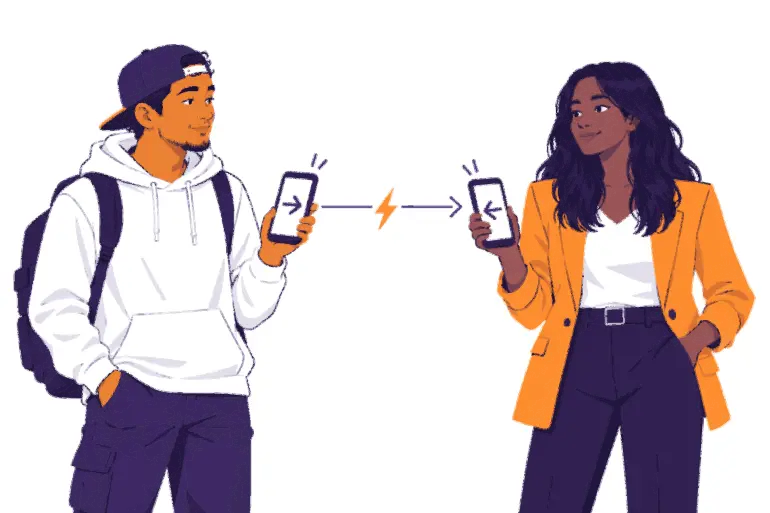
The receiver invoices

The receiver creates a payment request with the amount attached.

The sender pays

The sender scans the request, checks the amount and pays.

The receiver is paid

The payment arrives a moment later, and both are happy.

Know whether each wallet is custodial or self-custodial.
  1. 1Create the requestThe receiver creates a payment request.
  2. 2Scan the requestThe sender scans or copies it.
  3. 3Verify the detailsCheck recipient, amount, unit, expiry and fee.
  4. 4Approve the paymentThe sender approves it.
  5. 5Route the paymentIt travels across the Lightning Network.
  6. 6Check the resultBoth wallets show success or failure.
1Failed or expired? Confirm on both wallets, then make a new request.

Lightning can make fast, small Bitcoin payments practical. It may be suitable for a merchant counter, repeated local payments, online services, or transfers where an on-chain fee would be too large in relation to the payment.

A local Lightning demonstration should identify:

  • whether the wallet is custodial or self-custodial
  • how the wallet is funded
  • whether funding requires an on-chain transaction or a service
  • what backup or recovery protects the balance
  • what type of payment request is being used
  • what fees or limits apply
  • what happens when a payment fails
  • how the recipient confirms payment

A Lightning invoice is a payment request created for a specific payment. It can include an amount, destination information, and an expiry time. Read the wallet's confirmation screen before paying.

A Lightning address is a human-readable identifier supported by some services. It may look like an email address, but it is a payment-routing convenience, not an email account. It depends on the provider or domain that supports it.

For a guided payment:

  1. The receiver creates the correct request.
  2. The sender scans or copies it.
  3. The sender checks the recipient, amount, unit, and fee.
  4. The sender approves only after the details are correct.
  5. Both sides confirm the result in their own wallets.
  6. The group explains the custody and failure risks.

Do not assume that a successful Lightning payment proves the wallet is safe for larger balances. Payment convenience and custody security are separate questions.

Resources

4.6Daily-life Bitcoin use

Earning

Saving

Receiving

Sending

Spending

Donating

Pricing and accounting

Bitcoin can function as money in several ways. Spending is only one of them.

Earning: A worker, creator, business, or community member receives bitcoin for value provided. Earning can avoid a separate purchase process, but the receiver must agree on pricing, volatility, records, and custody.

Saving: A person holds bitcoin for future use. Predictable supply may be attractive, but the fiat exchange value can fall sharply and key security becomes important.

Receiving: A person accepts a gift, donation, refund, remittance, or repayment. The receiver must provide the correct payment request and verify settlement.

Sending: A person transfers value to family, friends, a business, or an organization. They must compare payment path, speed, fee, privacy, and finality.

Spending: A person exchanges bitcoin for goods or services. They should identify the exchange rate, merchant policy, payment method, and local tax consequences that apply.

Pricing and accounting: A person or business records value in bitcoin or sats. In many places, the fiat value at the time of payment is still needed for accounts or taxes.

Donating: A person supports an organization or individual directly. They should verify the recipient's payment request through a trusted source.

For any use, ask three questions:

  1. What existing problem does Bitcoin address here?
  2. Is Bitcoin better than the available alternative for this case?
  3. What new responsibility or risk does Bitcoin create?

Avoid starting with the tool. Start with the need.

4.7Local spending and receiving scenarios

Customer orders

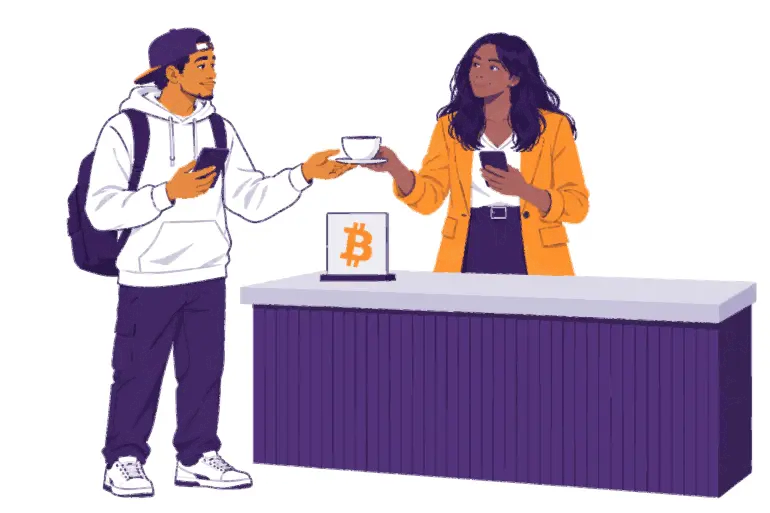
The customer asks for a coffee.

Server invoices

The server creates a payment request.

Customer pays

The customer pays in bitcoin.

Server hands over

The customer gets the coffee.

Use locally familiar goods and services. The exact item does not matter; the payment reasoning does.

Scenario 1: A small purchase

A customer wants to buy an everyday item. The merchant accepts Lightning and on-chain Bitcoin.

  • Which path is likely to suit a small, immediate payment?
  • Who creates the payment request?
  • How does the customer check the amount and unit?
  • How does the merchant know the payment succeeded?
  • What happens if the customer's wallet shows “sent” but the merchant does not see “received”?

Scenario 2: Payment for work

A worker agrees to receive part of a payment in bitcoin.

  • Is the price fixed in local currency, bitcoin, or sats?
  • At what time is the exchange rate determined?
  • Who pays any fee?
  • Is the receiver using self-custody?
  • What income or tax record is required?
  • Can the worker safely manage the amount?

Scenario 3: A transfer between family members

One person wants to send value to a family member in another place.

  • What are the costs and delays of the current method?
  • How will each person obtain or use bitcoin?
  • Does the recipient want bitcoin or local currency?
  • Which exchange and custody risks appear at each step?
  • Does the full route save time or money after all fees are included?

Scenario 4: A refund

A merchant needs to return value after an on-chain payment.

  • Why should the merchant request a fresh refund address?
  • How can the merchant verify that the request really came from the customer?
  • Who pays the return transaction fee?
  • What record should both parties keep?

Scenario 5: A community donation

A local organization wants to receive support in bitcoin.

  • How will donors verify the real payment request?
  • Who controls the receiving wallet and backup?
  • Will donations be received on-chain, through Lightning, or both?
  • What information should be public for transparency, and what should remain private for donor safety?
  • What records are needed for local accounting, tax, or reporting rules?

For a live practice, use a low-value item or a simulation. The learner should be able to explain the complete flow before approving payment.

4.8Local on-ramp and off-ramp pathways

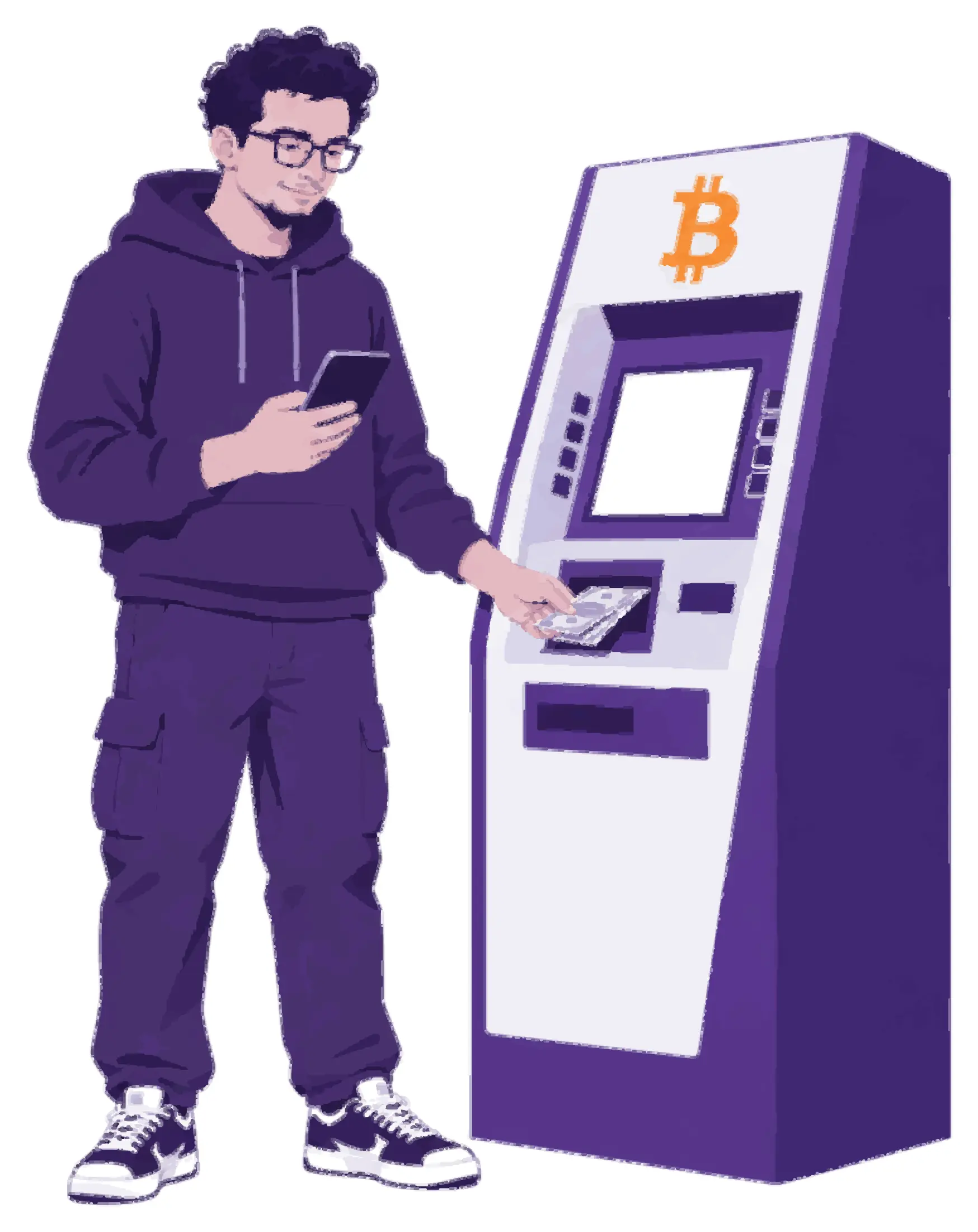
An on-ramp is a path from local money, work, or another asset into bitcoin. An off-ramp is a path from bitcoin into local money, goods, or services. The same pathway may perform both roles.

Local pathways may include:

  • earning bitcoin
  • buying or selling directly with another person
  • using an exchange or broker
  • using an ATM or kiosk
  • accepting or spending with a merchant
  • using a payment service that converts between bitcoin and fiat
  • participating in a local circular economy

Compare the complete route, not only the first fee. A service may advertise a low purchase fee but use a poor exchange rate or charge for withdrawal. A peer-to-peer path may appear private but require time, trust, and physical safety.

Check whether the path allows withdrawal to a wallet you control. A displayed bitcoin balance inside a closed service may be an internal claim rather than an on-chain balance under your keys.

For in-person exchange, use a public and appropriate location, avoid carrying unnecessary cash, bring a trusted person where suitable, verify payment before leaving, and follow local law. Do not reveal where you store bitcoin or how much you own.

Option A
Option B
Option C
Name
KYC requirements
Custody model
Networks supported
Reputation
Funding methods
Notes

4.9KYC and no-KYC trade-offs

KYC and no-KYC pathways make different trade-offs. Neither label removes the need for careful evaluation.

Privacy does not remove legal or physical-safety risk

Neither KYC nor no-KYC is automatically best. Compare the actual pathway, use current local guidance when rules are unclear, and do not break local law or expose yourself to physical danger in pursuit of privacy.

A KYC service may request a legal name, identity document, address, photograph, source-of-funds information, or other records. This may allow the service to meet local rules, connect to banks, set higher limits, or support account recovery.

KYC also creates data risk. The service may store a permanent connection among identity, payment methods, and bitcoin transactions. A breach, legal request, internal misuse, or change in policy may expose or restrict that information.

A no-KYC pathway may collect less identity information. This can improve financial privacy. It may also involve less regulated counterparties, lower liquidity, higher prices, reduced support, greater fraud risk, or legal restrictions.

Compare the real path:

Privacy is not secrecy from every risk. It is the ability to control information about yourself. Do not break local law or expose yourself to physical danger in pursuit of privacy. Seek current local guidance from a qualified person when the rules are unclear.

4.10Circular economies

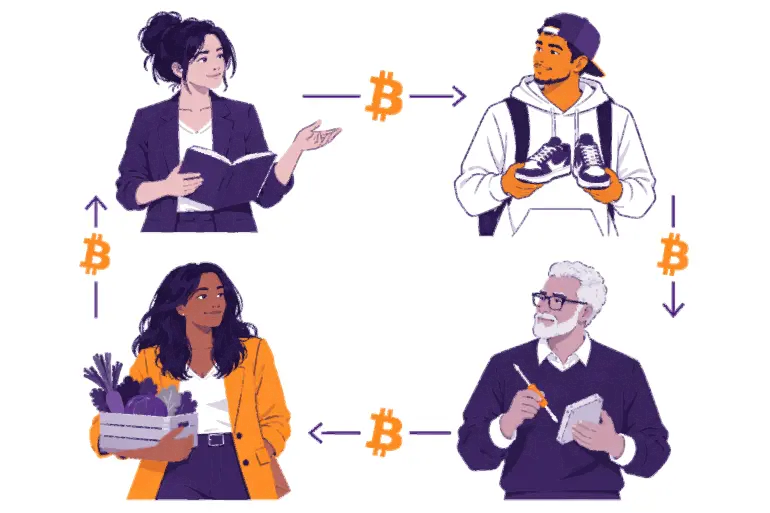
A Bitcoin circular economy is a network in which people earn, spend, save, and exchange bitcoin within a community. Value circulates among workers, customers, merchants, producers, educators, and service providers instead of entering only through a one-time purchase and leaving through immediate conversion.

Customer

The customer pays a merchant in bitcoin for goods.

Merchant

The merchant pays a service provider in bitcoin for a service.

Service provider

The service provider pays a worker in bitcoin for their time.

Worker

The worker spends that bitcoin again as a customer.

My First Bitcoin supports Bitcoin circular economies, and many are part of the Bitcoin Education Network. Explore these communities on the Network Dashboard.

A circular economy can reduce dependence on distant financial services and create direct local relationships. It can also fail if there is little demand, poor education, unreliable tools, weak security, or pressure to use bitcoin without a real need.

Map a simple local cycle:

  1. Who can earn bitcoin?
  2. Where can they spend or use it?
  3. Which merchants can pay a supplier or worker in bitcoin?
  4. Which participants need to exchange to or from fiat?
  5. Who provides education and technical support?
  6. What happens when internet access fails?
  7. What custody and price risks does each participant carry?

A healthy circular economy depends on voluntary participation. Merchants and workers should be able to identify the payment, pricing, custody, accounting, and volatility risks. Adoption numbers alone do not show whether the network is useful.

The strongest local loop solves a real problem for more than one participant. It should not depend permanently on giveaways or on one organizer processing every payment.

4.11Merchant or community use cases

Marketing

Training

Accounting

Sales

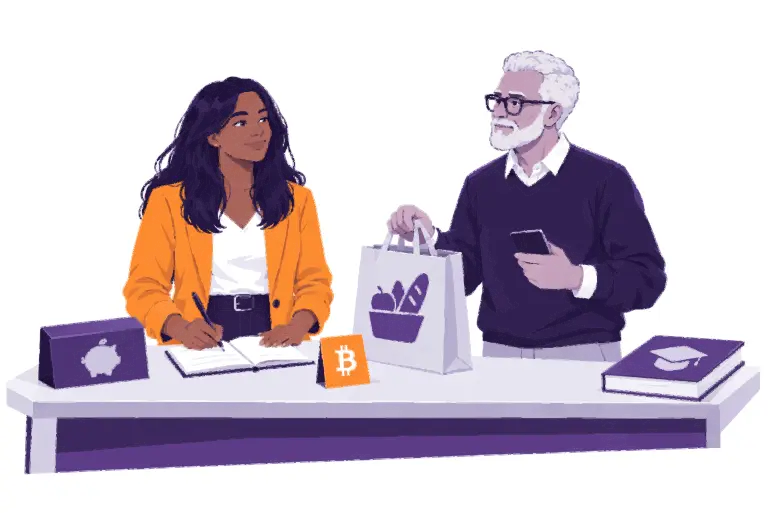
A merchant needs more than a receive button. The full payment process may include pricing, staff training, receipts, refunds, custody, conversion, accounting, taxes, device security, and support.

Before accepting Bitcoin, a merchant should decide:

  • whether prices are displayed in local currency, sats, or both
  • whether payments use on-chain Bitcoin, Lightning, or both
  • whether the wallet is custodial or self-custodial
  • who can access the receiving device
  • how received funds are secured or moved
  • whether some funds are converted to local currency
  • how payment is confirmed at the point of sale
  • how refunds and mistakes are handled
  • what records local law requires
  • what staff do when the network or wallet fails

Community use cases may include:

  • paying local workers or creators
  • receiving donations transparently
  • transferring value between community groups
  • supporting a savings group with clearly defined custody
  • helping a remote worker receive international payment
  • connecting local producers and merchants
  • teaching safe wallet use
  • providing emergency support where ordinary payment systems are unavailable

Community custody requires special care. If one organizer holds funds for many people, that organizer becomes a custodian and a point of trust. Shared funds need transparent rules, records, access controls, and legal review where appropriate.

For each use case, define success in terms of the problem solved, not the number of transactions completed.

Resources

4.12Local resource maps and community discovery

Detailed local-resource activities, record tables, and changeable listings belong on the Resources Hub. Maps and community directories can help you find merchants, educators, meetups, and circular economies, but listings can be incomplete or outdated.

Before relying on a listing, check when it was verified, confirm the information independently, and bring an alternative way to pay or participate. A local community can provide practical support, but membership is not proof of trustworthiness. Do not reveal seed phrases, balances, home addresses, or security arrangements at a meetup. Be cautious when a new contact offers investment management, private exchange, guaranteed returns, or urgent help.

Resources

4.13Review: Connect this to your community

  1. 1Real needWhat need did it address?
  2. 2Bitcoin fitDoes it beat a realistic alternative?
  3. 3Payment methodOn-chain, Lightning, or both?
  4. 4CustodyWho controlled the keys?
  5. 5Cost and trade-offsWhat are the benefit and the main risk?
  6. 6Local conditionsHow do law, culture and safety affect it?
  7. 7Evidence of successWhat evidence shows it worked?
Topic
Ask yourself
Your notes (optional)
Local need
What real need did it address?
Function of money
Earn, save, receive, send, spend, price or settle?
Realistic alternative
What realistic alternative did people compare?
Payment path
On-chain, through Lightning, or both?
Key control
Who controlled the keys?
Benefit and risk
What was the strongest benefit and the most serious risk?
Local fit and next step
How did local conditions matter, and what is a responsible next step?

Complete this review individually, then compare your reasoning with your team or cohort. Consider the local example you studied: what real need did it address, which function of money was involved, and was value moved on-chain, through Lightning, or both? Ask who controlled the keys, what the strongest benefit and most serious risk were, and how local law, infrastructure, language, or culture affected the result. A responsible next step is one that fits the local context, makes costs and custody clear, limits errors and scams, and can be evaluated against evidence.

Module 4 answer: Bitcoin can function as money when people voluntarily use it to earn, save, receive, send, spend, price, or settle value. The Connect stage begins with a real need, compares a realistic alternative, makes custody and costs clear, respects local law and safety, and gives learners enough knowledge to choose freely.

Key takeaways

  • Bitcoin as money is local: the useful pathway depends on community needs, infrastructure, laws, costs, tools, language, and safety conditions.
  • An educator-curated Module 4 Connect activity should link the Problem, Solution, and Action learning to a real problem or opportunity, realistic alternative, safe practice, and evidence of learning.
  • Local workshops should use a safe sequence: observe the process, practice with support, then explain or complete a defined task without exposing secrets.
  • Before using a local tool or service, check its purpose, custody model, source, recovery process, privacy, costs, compatibility, support, and current local rules.
  • On-chain and Lightning payments make different trade-offs in settlement, speed, fees, custody, and failure points; confirm which payment method a recipient expects.
  • Local exchange pathways, KYC choices, merchant flows, and community use cases should be compared through their full costs, custody, privacy, safety, and legal trade-offs.
  • A strong circular economy or community use case is voluntary, solves a real problem, protects participants, and does not make learners dependent on one service, organizer, or promise.

A moment to reflect

What question would you ask before deciding whether a Bitcoin path fits a local need?

↑ Back to table of contents